воскресенье, 31 марта 2013 г.

Rendering #7

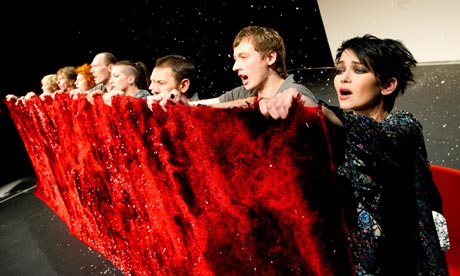
The article published on the website guardian.co.uk on March 27, 2013 is headlined Belarus Free Theatre to bring battle against death penalty to UK. It was written by Matt Trueman. The article reports the intention of Belarus free theatre to bring a visit at the summer 2013.
The article deals with the information about first Belarus perfomance in English that challenges the use of capital punishment around the world.
The author declares that Belarus Free Theatre will present a new piece – their first in English perfomance on such a serious theme. It's interesting that the company's co-artistic director Natalia Kaliada told the Guardian that they want to look at whether a state's use of capital punishment sets an example to its citizens and legitimises other forms of violence.
It is necessory to say that Belarus is the last European country to employ the death penalty! To my mind it's terrible! It's not strange that the EU and Human Rights Watch abandone the use of capital punishment! I think it's inhumane! at least we live in the 21 century!!!
The author of the article have some terrific examples of the capital penalty: 'Vladislav Kovalyov and Dmitry Konovalov, both 26, were put to death last March after being convicted of a bomb attack that took place less than a year before. Kovalyov's mother has since travelled around the world, maintaining her son's innocence.'
It is not surprising that certainly this theatre with its perfomancies is banned in Belarus and is cosidered as provocation.

Trash Cuisine will also feature testimonials drawn from some of the other 94 countries worldwide where the death penalty remains in use, including Thailand and Malaysia.
Personally I deeply appreciate such brave people and such actions! They go to those places where others don't get enough attention to these serious problem. They absolutely understand what it means not to be heard and they need to find those areas of the world that are hidden, where people's stories do not get a chance to be heard. It's wonderful that they do it through their perfomances! I hope they will be heard and some day the capital penalty will be banned in every country on the Earth.

воскресенье, 17 марта 2013 г.

Pleasure Reading #4

The second part of the novel is narrated by Miranda in the form of fragments from a diary that she keeps during her captivity. Clegg tries to please her around and Miranda beleives he is crazy. She realizes that everything is well planned and thought out for her. 7 days seem to be 7 weeks at the sellar. Сollectors is the worst on earth: anti-life, anti-art, anti-everything...The memories of her past vivid and exciting life absorb her gray reality. Miranda is still alive, but all the same she dead.

Years on end he sought in which he could embody his madness, and found Miranda.

Many of her diary entries are written either to her sister, or to a man named G.P., whom she respected and admired as an artist. Miranda reveals that G.P. ultimately fell in love with her, and subsequently severed all contact with her. Through Miranda's confined reflections, Fowles discusses a number of philosophical issues, such as the nature of art, humanity and God.

Pleasure Reading #3

Miranda makes the first serious attempt to deal with such a miserable, oppressive existence. In one of their evening walks in the garden she rushes to Clegg with an axe. Certainly, the attempt failed, because Clegg's actions were carefully planned.

Miranda thinks that Clegg has sexual motives for abducting her. She tries to have sex with him, but after Clegg's rejection, she realises that this is not true. After her sexual attempt, Clegg stops to respect her, because now Miranda is no more  than other ladies 
for him.

Miranda tries all ways to escape: hunger strike, ignorance, deliberate murder and even sex.

Every day it was harder for the young lady to live in the cellar. Miranda has become worse. Clegg did not call her doctor. he was afraid of losing his "batterfly" in the collection.

She had a bad cough, she had not eaten for several days and did not come out of her cell. Frederick considered it as a new way to escape him.  And when he realized that she does not play the role, it was too late. Miranda died. 

пятница, 15 марта 2013 г.

Rendering #6


The article published on the website The Stage on March 15, 2013 is headlined Our theatres must not be soft targets. It was written by Samuel West. The article reports the information about the problems of British local theatres.

Here’s what’s happening: local government cuts are disproportionately hitting our cities, where most of the theatres are. In 2010, it was announced the first 100% arts funding cut.
The author gives some examples: Sheffield Theatres is facing a council cut of £100,000, just weeks after being named regional theatre of the year at the The Stage 100 Awards. Westminster has an arts budget of £350,000 – just 0.04% of its total spend. They want to cut all of it. Arts funding as a gift, and art as an add-on. Because they believe that in the absence of investment, art will happen anyway. Some may, but most won’t.
Samuel West emphasizes that a way out is to find new ways to engage the public with the value of art and culture.Get every theatre in the country to talk to its public, and get those audiences to shout loud for an excellent, affordable night out. Turn your audience into advocates. Through articles, postcards, curtain speeches, build a movement and a database; hundreds of grassroots champions every theatre can call on to say how that theatre has changed their lives.
the My Theatre Matters! campaign which is running throughout 2013 should help to make opportunities and employment for those who don’t traditionally engage with the arts."We must trumpet the economic benefits of a thriving theatre and how culture can revitalise a tired city centre." - declaim the supporters of 'the My Theatre Matters!' and I fully agree with them.
Our local theatres are an indispensable part of people becoming who they are. Despite the actions of the government we should try our thetres in any way, and such campaigns as 'the My Theatre Matters!' just help us in it!

Rendering #5


The article published on the website of the Official London Theatre on February 4, 2013 is headlined Liar Liar. It was written by Kate Stanbury. The article reports the information about the perfomance wich is called Liar Liar.


The reporter begins the article with the questions. It can't but attracting my attention, because I start to think over them and in such a way I'm closer to the content of the article.

Liar Liar is the story about relationships of modern teenagers and their relationships with different computer games most of which are really cruel.

The author of the article emphathises that Liar Liar looks at the younger generation’s dependence on technology and questions the potentially dangerous effects that violent video games can have on those who play them.

One more theme which Liar Liar touches is lying. For Grace (the main hero), the young teenager at the heart of EV Crowe’s new play Liar Liar, lying is a pastime. For Grace, lies are like the air that she exhales. She lies about where she’s been and what she’s done and cares little about the consequences.

To my mind the themes of this perfomance is really burning nowadays. Lying of teenagers and cruel computer games may have some tie. that's why I think it'll be interesting and useful to watch it!


воскресенье, 10 марта 2013 г.

Rendering #4

The article published on the website of the newspaper ARTNews on February 25, 2013 is headlined Gilty Pleasures: The Guggenheim Reframes Its ClassicsThe article reports the information about reframing modernist works from the Thannhauser collection in period frames dating back to the 17th century.
the author of the article reports that Justin K. Thannhauser, the German art dealer who gave the Guggenheim the collection of some 75 early modernist paintings, preferred heavy, ornate frames. Now one by one canvases by Picasso, Manet, van Gogh, and Gauguin in the Guggenheim Museum’s Thannhauser Collection are coming to life in new frames.
By 1978, two years after Thannhauser’s death, those frames had been replaced with the white shadow frames favored by Thomas M. Messer, the Guggenheim’s director at the time. In 2006, when the cleaning and restoration of important Thannhauser paintings, including Pissarro’sThe Hermitage at Pontoise (ca.1867), underscored the bad condition or the unsuitability of their frames a committee was formed to choose the most historically and esthetically appropriate frames for the pictures. 
The author of the article gives some exmamples: Picasso’s Le Moulin de la Galette (1900) was hanging in a thin 20th-century reproduction frame in 2006, but photographs of Thannhauser’s apartment revealed that it had once had a deeply carved 17th-century Florentine Baroque frame.
For Braque’s colorful Landscape near Antwerp (1906), the group commissioned New York framer Gill & Lagodich to custom-make a replica in honey-colored maple of a simple flat frame designed by French Neo-Impressionist Paul Signac.
It's is remarkable that this project has the  worthy budget. I think that museums in our country, unfortunately,hasn't got such opportunity.

суббота, 9 марта 2013 г.

Rendering #3

The article published on the website of the newspaper the Guardian on March 4, 2013 is headlined What can Spielberg learn about Napoleon from art? The article reports the information about the famous Steven Spielberg and his intention to create miniseries of Kubrick's Napoleon. The author of the article has a question: 'Does Steven Spielberg want a hero or a villain?' because the personality of Napoleon Banaparte was very complicated. Now that Steven Spielberg is making Kubrick's Napoleon into a miniseries, the potent images of Old Boney that loom in the art of Europe are likely to be studied by designers, cinematographers and actors.
It is not a secret that the attitude towards Napoleon was ambiguous. Not all artists were convinced, though – not even in France. For example Jean-Auguste-Dominique Ingres painted an official portrait of the emperor on his throne that somehow manages to make its sitter monstrous.
Napoleon's image even fascinated his enemies. The strangest official portrait of him can be found in a most unlikely place. Visit the home of Napoleon's nemesis the Duke of Wellington at Number 1 Hyde Park, and you will find Canova's nude marble statue of Napoleon. Made for Napoleon himself, it was given to Wellington as a war prize. It is a marvel – the conqueror of Europe as a naked curiosity.
At the end of the article it is emphasized that Spielberg has an amazing archive of Napoleonic portraits from which to resurrect this enigmatic historical personality. He is the great master of cinema industry and I suppose his work will be appreciated. 
My attitude towards Napoleon is ambiguous too. He was the hero of his time as well as Stalin and Hitler. To my mind our history can't exist without such strong personalities!