воскресенье, 31 марта 2013 г.

Film Review #2 Anonymus

Anonymus (2011)


Cast: Rhys Ifans, Vanessa Redgrave, Sebastian Armesto, Rafe Spall

Director: Roland Emmerich

Writer: John Orloff

Genres: Drama, History, Thriller

Sinopsis: Edward De Vere, Earl of Oxford, is presented as the real author of Shakespeare's works. Edward's life is followed through flashbacks from a young child, through to the end of his life. He is portrayed as a child prodigy who writes and performs A Midsummer Night's Dream for a young Elizabeth I. A series of events sees his plays being performed by a frontman, Shakespeare.

Review: History takes us to England of the 16th century, in the Elizabeth's reign. The plot is based on a theory that under the name of Shakespeare actually created another person, in particular the Duke of Oxford Edward de Vere.


There is an interesting image of William Shakespeare, which we used to take a genius at school-age. In 'Anonymus'  he is a third-rate player, drunkard, a crook, a person who wants only to earn  money and fame in any way, which is randomly became the greatest playwright.

"Anonymous" is not only a kind of disclosure of the Shakespeare's secrets, but also a great movie in terms of policy. Here we can see the intrigues and betrayal behind Queen Elizabeth I, we will be shown how even the powerful people sometimes may make mistakes.

through this film I felt the atmosphere of Shakespeare's times. I was absorbed by it. For me it's so amazing to    learn the way people dress, the way they think and feel...and all this I get while watching these drama.

To my mind this film is worth for seeing! Anonymous is Emmerich's masterpiece, a radical far from his usual environmental apocalypse works. There could be a stigma surrounding the subject, which will be viewed as blasphemy by many. I'd like to reassure you that most popular cinema is an act of fiction. Shakespeare isn't available to rebut, and most moviegoers are not concerned with historical accuracy so long as the story is compelling and filled with drama, which Anonymous delivers.

Pleasure Reading #6

The third part of the story is the shortest one. It is again narrated by Clegg. After the death of his "butterfly" he is confused, he understands northing. Miranda was the breath of life for him. he loved the way he loved her. He loved his love, but not her... At first, he wants to commit suicide but after he reads in her diary that she never loved him, he decides that he is not responsible and is better off without her. The books ends with his announcement he plans to kidnap another girl.

Pleasure Reading #5

Сlock in the world fallen behind for eternity since she found herself in prison. Miranda tries to escape several times, but Clegg is always able to stop her. Miranda considers that she can't be regarded as the prisoner if she doesn't try to escape. She also tries to seduce him in order to convince him to let her go. She is one of the most beautiful specimens of his collection. When she tries to flutter her wings to get out, Caliban (one more his name) is experiencing the deepest hatred for her. The only result is that he becomes confused and angry. When Clegg keeps refusing to let her go, she starts to fantasize about killing him. After a failed attempt at doing so, Miranda passes through a phase of self-loathing, and decides that to kill Clegg would lower her to his level. As such, she then refrains from any further attempts to do so.

The second part is full of dialogues between Miranda and Caliban. Caliban told his essense, we may understand his outlook. He told that Miranda is everything for him. Without her there will be nothing.
Before she can try to escape again, asks G.V. to not let her die but, unfortunately she becomes seriously ill and dies.

Rendering #8

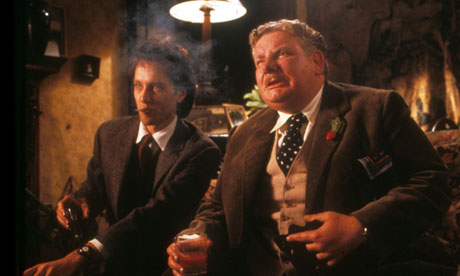
The article published on the website guardian.co.uk on March 29, 2013 is headlined Richard Griffiths: comic master who gave us the unforgettable Uncle Monty. It was written by Peter Bradshaw. The article is dedicated to Richard Griffiths who recently died on March 28, 2013.
Richard Griffiths was an English actor of stage, film and television. He was never a leading man, not as such, although his leading role as the schoolmaster in the Alan Bennett play and movie The History Boys won him a raft of prizes. He was the quintessential supporting character actor, and his massive physical presence was lasered into the minds of a young generation as Harry Potter's malign foster father, Vernon Dursley. I remember his role in Harry Potter's and for the first time I was afraid of him, but now I realise that it was a small but at the same time great role of a talented person.
The role, that made him a legend was Uncle Monty in Bruce Robinson's great film: the corpulent, fastidious bachelor – lonely and predatory as a certain type of Oxford don – whose semi-derelict country cottage Withnail secures for the much-needed restorative weekend, having given Monty to understand that his cute friend Marwood will submit to his sexual advances.  
He was unforgettably brilliant, anyway. His glorious voice – everyone quotes Monty's lines from Withnail, but no one can do justice to Griffiths's resonant melancholy or the quick, thin-lipped snap of his sudden petulant temper. He had a wonderfully pained moan on the "never" in "never play the Dane". He relished the bizarre sensuality in "There is a certain je ne sais quoi about a firm young carrot".
In conclusion I'd like to say that it's always uneasy when people leave us. Yesterday we left the great actor Valery Zolotukhin...
Richard Griffiths, that superb comic actor, found the role of a lifetime, grabbed it with both hands – a figure who combined Sir Toby Belch and Andrew Aguecheek with a tiny cantankerous touch of Morrissey. We will all be grateful to him for creating this masterpiece.

Rendering #7

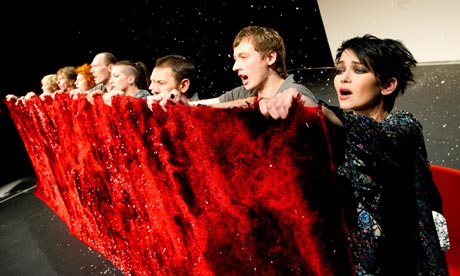
The article published on the website guardian.co.uk on March 27, 2013 is headlined Belarus Free Theatre to bring battle against death penalty to UK. It was written by Matt Trueman. The article reports the intention of Belarus free theatre to bring a visit at the summer 2013.
The article deals with the information about first Belarus perfomance in English that challenges the use of capital punishment around the world.
The author declares that Belarus Free Theatre will present a new piece – their first in English perfomance on such a serious theme. It's interesting that the company's co-artistic director Natalia Kaliada told the Guardian that they want to look at whether a state's use of capital punishment sets an example to its citizens and legitimises other forms of violence.
It is necessory to say that Belarus is the last European country to employ the death penalty! To my mind it's terrible! It's not strange that the EU and Human Rights Watch abandone the use of capital punishment! I think it's inhumane! at least we live in the 21 century!!!
The author of the article have some terrific examples of the capital penalty: 'Vladislav Kovalyov and Dmitry Konovalov, both 26, were put to death last March after being convicted of a bomb attack that took place less than a year before. Kovalyov's mother has since travelled around the world, maintaining her son's innocence.'
It is not surprising that certainly this theatre with its perfomancies is banned in Belarus and is cosidered as provocation.

Trash Cuisine will also feature testimonials drawn from some of the other 94 countries worldwide where the death penalty remains in use, including Thailand and Malaysia.
Personally I deeply appreciate such brave people and such actions! They go to those places where others don't get enough attention to these serious problem. They absolutely understand what it means not to be heard and they need to find those areas of the world that are hidden, where people's stories do not get a chance to be heard. It's wonderful that they do it through their perfomances! I hope they will be heard and some day the capital penalty will be banned in every country on the Earth.

воскресенье, 17 марта 2013 г.

Pleasure Reading #4

The second part of the novel is narrated by Miranda in the form of fragments from a diary that she keeps during her captivity. Clegg tries to please her around and Miranda beleives he is crazy. She realizes that everything is well planned and thought out for her. 7 days seem to be 7 weeks at the sellar. Сollectors is the worst on earth: anti-life, anti-art, anti-everything...The memories of her past vivid and exciting life absorb her gray reality. Miranda is still alive, but all the same she dead.

Years on end he sought in which he could embody his madness, and found Miranda.

Many of her diary entries are written either to her sister, or to a man named G.P., whom she respected and admired as an artist. Miranda reveals that G.P. ultimately fell in love with her, and subsequently severed all contact with her. Through Miranda's confined reflections, Fowles discusses a number of philosophical issues, such as the nature of art, humanity and God.

Pleasure Reading #3

Miranda makes the first serious attempt to deal with such a miserable, oppressive existence. In one of their evening walks in the garden she rushes to Clegg with an axe. Certainly, the attempt failed, because Clegg's actions were carefully planned.

Miranda thinks that Clegg has sexual motives for abducting her. She tries to have sex with him, but after Clegg's rejection, she realises that this is not true. After her sexual attempt, Clegg stops to respect her, because now Miranda is no more  than other ladies 
for him.

Miranda tries all ways to escape: hunger strike, ignorance, deliberate murder and even sex.

Every day it was harder for the young lady to live in the cellar. Miranda has become worse. Clegg did not call her doctor. he was afraid of losing his "batterfly" in the collection.

She had a bad cough, she had not eaten for several days and did not come out of her cell. Frederick considered it as a new way to escape him.  And when he realized that she does not play the role, it was too late. Miranda died.